
The California based queer artist, academic and curator Việt Lê on his process, fashion and the politics of identity.
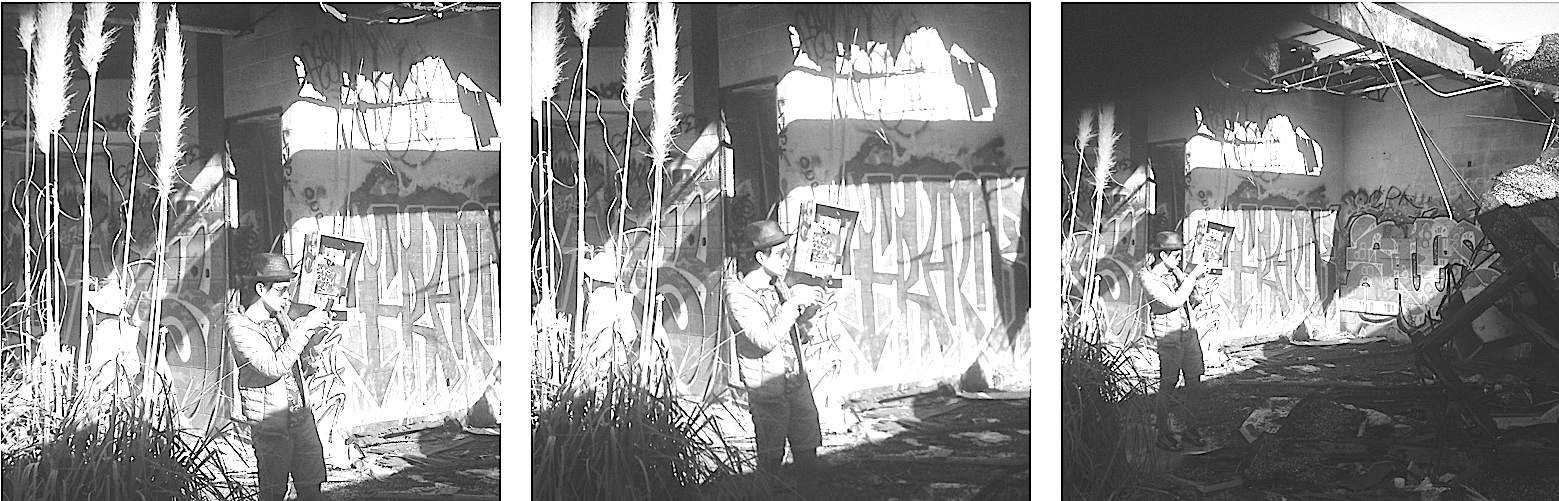
Việt Lê’s practice is post-studio which makes visiting him online while he is running errands at a LA shopping mall as appropriate as dropping in at Warhol’s Factory.
Though repeatedly referring to himself as ‘shallow’ citing his love for fashion and soft spot for pop culture, he is anything but that. He is an academic and conceptual artist, community activist and art curator. And queer across those disciplines, which makes for the perfect cross stitch to sew together one very intriguing exploration of identity.
From photography, to painting, to performance art and video productions Việt Lê has worked with a multitude of media. Being productive and active across so many fields makes the exploration of how and why he does it all the more worthwhile.
Interview by Fabiola Buchele ●
&: Is your art political?
Việt Lê: Yes. My friend Dinh Q. Lê said something really wonderful: he said artists are public intellectuals. I don’t necessarily think of myself as that but I look to other artists to viscerally learn about the world. Where else can you see the world through someone else’s eyes and feel it? Through literature, through art!
All my art and research and curatorial work is politically motivated. You might not see it, it might look fluffy to you, but that’s a strategy. For some artists, I see humor as a strategy to talk about other social and political concerns. My friend Kristina Wong, a performance artist, she says she uses humor to just reel them in and then kick them in the guts. And I think I do a similar thing, just fluffy stuff—oh you know like sexy music videos— but then to talk about these deeper things like the traumas of history and modernisation.
&: Do you identify as a queer artist?
Việt Lê: I definitely identify as a queer artist. Our standards of heteronormative and homonormative success is basically getting married, getting a house, etc.. this goes along a certain timeline, but if you are queer, those timelines don’t fit and you don’t necessarily want to succeed at them. So you may want to opt out, to “fail.” Jack Halberstam’s Queer Art of Failure posits the political, creative and critical possibilities of failure, and I think that’s important. I think of it as thinking through these binaries. I’ve also been out as an artist since I was very young and sometimes it’s been difficult. LGBTQ identity can be problematic and has been critiqued as a particular dominant narrative. The framework of “coming out”/ visibility does not always work for everybody.
&: Can being a queer artist be restrictive?
I understand and know also from a curator’s and activist’s point of view people are still being discriminated, still being killed for their subject positions so identitarian politics are still vital.
Việt Lê: The flexibility of queer frameworks is productive. As a Vietnamese/ Vietnamese American queer artist there are certain expectations about representation, the politics of identity— ‘oh yes he’s in a Vietnamese show, he’s in a LGBT show.’ I understand and know also from a curator’s and activist’s point of view people are still being discriminated, still being killed for their subject positions so identitarian politics are still vital. In the United States we are in a state of war—people are being killed abroad and at home.
The interrelated lines of race, sexuality, class—oppression, suffering, it appears in my own work. That’s also why I feel community building or collaboration is important: making these violences visible within and without institutions that would not have us.
&: How do you choose your medium for your art?
Việt Lê: I’m a little bit schizophrenic, I like to think of medium as lovers and I am all for poly-amory. For me, with conceptual art it’s about what is the best medium for the idea. Often, with photography it’s the relationship between myself and the subject. For instance, I have done an ongoing series of gay male nudes in their domestic space. I really want this ethnographic interaction and so it couldn’t be a painting, because I can’t talk literally to a painting.
For paintings I want to really meditate on an image and for performance it’s a sort of relationship between myself and the audience and the space that is embodied. And for video it’s a compression of time, space, performance, music, fashion and architecture that I can’t conjure in a painting. Experimental video combines all of my interests. I can’t necessarily bring people to these sights, but I can conjure it through moving images, gesture and sound.
&: You use your own body in your performance. As a self professed introvert this must make you feel incredibly vulnerable. How do you deal with that and why do you do it?
Việt Lê: Thanks for recognising that. I am shy and I am also quite shy as a professor or as a public speaker but I have to do interviews and do public talks all the time and the way I get over that is that I am sharing these things that are more important than me.
I think I am beyond the idea, maybe it’s my midlife crisis, of the individual artist—you live in a community, ideas are common goods, our commonality.
For performance, it’s not me, it’s a character. Often times as an artists you can’t get models to do things that you would like them to do—like getting naked. So I end up having to be the model. Some people are not comfortable with nudity and crawling on the ground in mud so that’s my shtick, I do that. That’s how it started.
And also growing up with invisibility not seeing myself, not literally myself, but queer, Asian minority figures on screen… it think it’s crucial to have that kind of representation—so not me per se, people like me, like us, who are out there—who are visible. I think I am beyond the idea, maybe it’s my midlife crisis, of the individual artist—you live in a community, ideas are common goods, our commonality.
&: Do you use a sketchbook and do you tend to jot down ideas in words or sketches?
Việt Lê: Both, I used to have a kind of sketchbook journal that I would write obsessively in. But I am getting too old or lazy so I don’t do that anymore. But when I am working on projects I use a sketchbook and I also have an inspiration folder where I put all my shallow fashion and image obsessions. For the last video I was really obsessed with Alexander McQueen, Eiko Ishioka, and certain aesthetics, so each character has a little folder and they have a look-book/ mood board because I am so obsessed with fashion.
&: Where does the fashion obsession coming from?
Because I am Asian there are a lot of stereotypes that exists, so some days I’d go to work or school as an Asian gangster or I’d go to work as Asian nerd and sometimes women’s clothing, that kind of stuff. It’s gotten more subtle, but I still do it when I teach.
Việt Lê: I think artists such as Nikki S. Lee or Cindy Sherman or even fashion designers, haute couture or low-end, are about this construction and deconstruction of identity. For queer identities often times how you present yourself or represent yourself is through fashion. So I express my characters through fashion.
I sometimes go to work— I started doing this as an undergrad—as different characters. Because I am Asian there are a lot of stereotypes that exists, so some days I’d go to work or school as an Asian gangster or I’d go to work as Asian nerd and sometimes women’s clothing, that kind of stuff. It’s gotten more subtle, but I still do it when I teach.
Sometimes students are like oh yeah it’s interesting that you are wearing some weird surrealist outfit and you’re talking about surrealism today. But I am more interested in gender ambiguity. Most of my clothes are actually women’s clothes. That’s the obsession with fashion, it constructs whole worlds and identities and sexualities, plus again I am shallow…
And the construction or the manufacturing of fashion is also problematic, you know there is a glamorous aspect to it, but then it’s also the real geopolitics where these factories in Cambodia, Vietnam or other parts of the world where there is cheap labour.
When I was little I used to work with my mum in a sweatshop in the United States, really a dollar an hour, that kind of wage. We would do it at home, that was my day to day when I was young. So I am also really interested in the dark side of fashion, it exists. The Ironies of Freedom and The Beautiful Generation are two books that deal with gendered and raced global labor economies.
&: What are the tools you use?
Việt Lê: My laptop, community and ideas. For me, post-Duchamp, it’s not about specific material tools per se but ideas. So for me the essential tools are having you, the idea and my laptop. I can connect to the inter webs and collaborate. I can do research research and connect to the different communities in which I am a part of so that we can talk about these different ideas and help make them manifest.
The Internet as well as libraries for research are essential. As an artist you are bound to the geographical locations but like we are doing right now (Skyping), through technology it really helps that we can reach outside our physical location.
I am sort of post-studio. I have an office and a desk where I sit most of the time. And I just write critically or creatively. I don’t paint as much any more so I don’t need a physical studio space.
&: When and how do you work?
Việt Lê: I am totally not a morning person, but I work all the time, from the time I wake up, but I am more of a late afternoon, evening, nighttime person
When I am writing I don’t listen to music, because I am trying to focus on difficult and depressing thoughts, but when I’m making art or doing research about a particular theme I try to select a soundtrack that fits the mood or idea. People will really think I am kind of brainless, because I’ve been listing to a lot of pop music. More recently I’ve been listening to country music.
●●
This article is part of the & Of Other Things special queer edition created for the Queer Forever! Festival organised by Nhà Sàn Collective. To find out more about their events and program visit their Facebook Page.
Read more:
Silent Interview: What Moves Me
In Conversation: Queer Art & Activism
Photography: Moments of Freedom


